

The 802 Ed
What's going on in Vermont education policy and practice
Welcome back!
This issue of the 802 Ed covers many topics that are immediately useful like the upcoming exit of the House Education Committee chair, an escalation of the Read Vermont conflict between lawmakers and AOE, and a stalled bill to pay for PCB testing and remediation. Be sure to check out the recent global ransomware attack that also hit Vermont’s education scene!
New to the lingo? At the suggestion of a reader we include a guide to common abbreviations, just scroll down past the news.
- Steven Berbeco, Editor

School Leadership
Doubling Planning Time. Education Week zooms into schools that have managed to increase teachers’ planning time without sacrificing students’ instructional time.
Canvas v. ShinyHunters. New York Times sums up the resolution of a recent ransomware attack on schools and universities around the world, including Vermont. Gift link
“Ready for A Break.” Seven Days VT breaks the story that the Chair of the House Education Committee won’t seek re-election.
Finger-Pointing in Montpelier. VT Digger lifts the veil on a blame game between AOE and lawmakers over $700,000 in funding for the Read Vermont literacy program.
Sing to Read. The Hechinger Report highlights research that points to the connection between singing and early literacy.
Barre Votes It Down. WCAX gives us the update on one school budget vote that failed and another that passed. The VSA’s unofficial scoreboard puts it at 114-10 statewide.
Save The Cookies. VT Digger reports on a bill banning certain chemical food dyes was shelved when major school districts argued the change would create extra administrative work for minimal practical impact.
$566,000 Settlement. Seven Days VT gets the scoop on the outcome of a lawsuit that alleged the VPA barred a school’s students from participating in sport competitions because of religious beliefs. This was a popular item in last issue, so here it is again for readers who may have missed it.
Road to Nowhere. Hechinger Report brings us up to date on an effort to track thousands of students who went through career pathways in high school and ended up on a different professional trajectory.
Did Cell Phone Bans Work? New York Times offers a glimpse at a recent study that shows mixed results when cell phones aren’t permitted in school. Gift link
“The Toothpaste Is out of The Tube.” VT Digger reports that the Senate has balked at a bill ending PCB testing in schools: “I don’t think, as a state, we want to go to court when some child gets sick, and say, ‘Well, we didn’t have the money.’”
Big Plans, Thin Wallets. Seven Days VT goes deep into the story of how lawmakers are advancing major school reforms while struggling to pay for them, fueling concerns about a growing pile of unfunded mandates.
Heads Up, Vermont. States are taking innovative steps to support their students. Vermont school leaders and lawmakers should take note:
Many states are copying Kentucky’s program that provides free child care for most early childhood educators.
California is launching its first registered apprentice program for teachers, giving education students the opportunity to also earn a wage as they learn.
School Shootings in 2026. Education Week’s tracker has logged 12 school shootings in 2026. “On May 5, a 39-year-old woman and 15-year-old boy were shot and killed on Southwest Elementary School property in Grand Rapids, Mich. There was a parent event happening inside the school when the incident occurred.” Total school shootings in 2025: 18. As a reminder, DPS and AOE operate an anonymous school safety tip line for students, school staff, and their community: calling 1-844-SAFE4VT; texting SAFE4VT to 274637; or online at safe4vt.org. For questions about school safety training in Vermont, contact Sunni Erikson.

Buzz On The Street
This sections highlights recent op-eds and letters to the editor about education.
Jay Nichols argues that modern nicotine products disguised as everyday school items are fueling youth addiction in Vermont schools: “They are designed to get middle and high schoolers addicted to nicotine.”
Ginger Schwab expresses disappointment that a student protest was held during school hours: “This decision sends our children the message that adult political activism can outweigh their education.”
Rory York contends that respect for people’s pronouns on a college campus has faded from active social practice into empty habit: “For many people, having their pronouns recognized is directly tied to their sense of safety and well-being.”
Reader Survey
In each issue we ask a survey question to get a sense of what is on our readers’ minds. Then, the following issue, we report back on what we learned.
Last issue we asked: Who should have primary responsibility for reducing youth vaping? Responses were strongest for State government, like AOE and VDH. Only a couple readers selected Supervisory unions, school districts, and schools.
This issue’s survey question: Do you think Vermont lawmakers understand the realities facing local schools and educators? Please indicate your response by clicking a check mark.
✅ Yes, they are well-connected
✅ No, they seem to have little idea
✅ I’m not sure
Thank you to the reader from Chittenden County who suggested that survey question. What’s on your mind? Suggest a survey question to find out how your colleagues respond in an upcoming issue of the 802 Ed!

Listen Up
Check out the 802 Ed’s conversation-style podcast! Generated by Notebook LM
Job Listings
Supercharge The Applicant Pool. The market for school staff in Vermont is fierce and it’s important to stand out when attracting quality candidates. Why get wedged in among thousands of open positions on SchoolSpring? Your opportunity can stand out in an upcoming issue of the 802 Ed, dropping into the Inbox of thousands of readers. Sponsored by 802 Ed
School Leader Vacancies. Latest report from VPA counts 79 school leader positions, like principal and assistant principal, that are turning over for next school year.
The Big List. Josh Czupryk compiles and publishes a monthly spreadsheet with more than 600 job opportunities for remote work in K-12 education.
Looking for a Change? With so many open jobs, there are sometimes unusual opportunities. For example, word has gone out for a Chief Trophy Officer to deliver the Superior Player of the Match trophy for the World Cup, with compensation of $90,000 for an hour and a half gig.

Thank The Team
You read it, you love it, and now is a good time to say thanks. Cover our coffee budget! Writing, editing, researching… all of that is caffeine driven. Choose this option and the extra energy will go to finding a few more updates to share.

Note From The Editor
In June here in Vermont, the noise settles as teachers count field trips instead of fire drills and seniors drift through hallways like ghosts already halfway gone.
Meantime in Montpelier, lawmakers are still arguing about how to rebuild the entire education system.
Everyone agrees the bridge is cracking, but nobody agrees whether to reinforce it, replace it, or paint it green and form a study committee.
That disconnect sits at the center of the state’s education reform debate. While legislators battle over district consolidation, governance structures, and funding formulas, educators are stacking chairs for the summer without knowing whether their school will be closed in two years as collateral damage.
It’s clear that lawmakers are divided over Act 73 and the future of school consolidation. Some argue Vermont needs larger districts and mandatory mergers to control costs and create equity. Others warn that forced consolidation would erase local voice and hollow out rural communities.
Both sides are right about at least one thing. Vermont’s education system is financially strained. The reality of declining enrollment and climbing property taxes can’t simply be wished away with another committee report and a Statehouse ice cream social.
The people resisting rapid consolidation are not defending inefficiency for old times sake. They are defending the small-scale civic glue that keeps rural life functioning. A school in Vermont is rarely just a school. It is the gym where the town gathers after floods, the place where people vote, the winter concert, the basketball banners, the social heartbeat. That is why this debate feels less like accounting and more like identity.
And yet the clock keeps ticking toward summer. This time of the year in education is both a finish line and a starting gun. Schools move forward whether we are ready or not. New budgets arrive, new staffing shortages emerge, new challenges walk through the doors in August.
The children keep moving. Government should, too.
Eye on Data
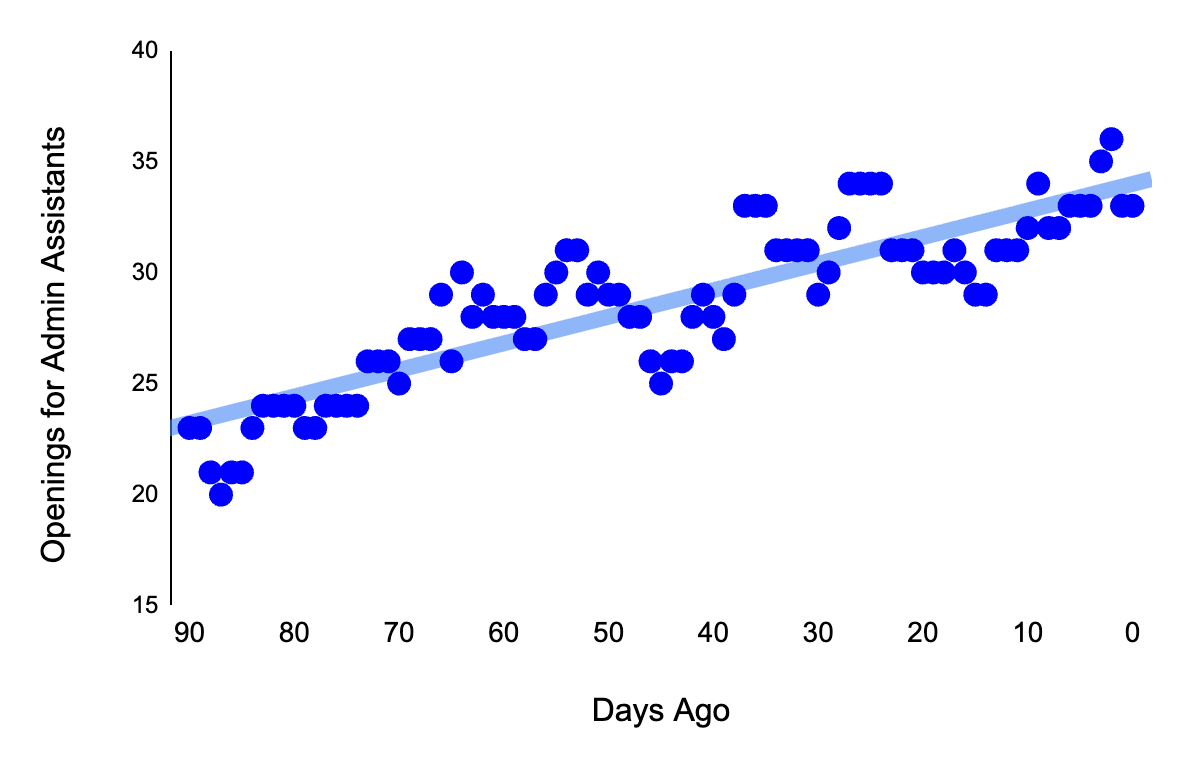
The chart below tracks number of open positions for administrative assistants in Vermont in the past 90 days, presented as data points and a linear trend line. Data from SchoolSpring.
Pass It On
Like what you are reading? Hit the button below to send a copy to a colleague, friend, neighbor, your boss… whoever!

Grants & Opportunities
Intensive Needs. AOE has published an RFP for a contractor to train education teams on intensive special education services. Deadline in May 20.
Testing Classroom Tools. The National Museum of the American Indian is looking for educators to conduct usability testing by Zoom of a new digital resource, between May 27 and May 29, for an hour. Honorarium is offered.
Financial Hub. University of Vermont is looking for a contractor to centralize administrative and financial services for the College of Arts and Sciences. Deadline is June 1.
Summer Fellowship in Design. The Smithsonian Environmental Research Center is offering a stipended, 3-day workshop in August for middle and high school teachers who teach arts, geography, or STEM to learn how to use authentic environmental data and design practices. to not only engage with data but understand how to make real-world change. Deadline is June 14.

If You Missed It
Fewer Books Per Year. Analysis from the Rand Corporation points to a reduction in the role of full books in schools’ reading programs: “Survey results suggest that full-book reading remains peripheral in most secondary [English Language Arts] classrooms.”
AI Bill Backlash. Statewide education groups are urging senators to reject H.650, arguing the education technology bill would overburden school leaders and sideline recommendations developed by state education organizations and AOE.

Since 2021 the biweekly 802 Ed has brought together the latest from Vermont’s associations for principals, superintendents, and school board members, as well as state and national education agencies and many other news sources. We hope that you’ll find something useful in each issue and welcome comments or suggestions for upcoming issues: editor@802ed.com.
Abbreviation list: AASA School Superintendents Association, AOE Agency of Education, CTE Career and Technical Education, DCF Department for Children and Families, DMH Department of Mental Health, DPS Department of Public Safety, FERPA Federal Educational Rights and Privacy Act, NAEP National Assessment of Education Progress, NEASC New England Association of Schools and Colleges, RFP Request for Proposals, SBE State Board of Education, SEL Social Emotional Learning, UVEI Upper Valley Educators Institute, VDH Vermont Department of Health, VEHI Vermont Education Health Initiative, VPA Vermont Principals Association, VPO Vermont Political Observer, VREC Vermont Rural Education Collaborative, VSA Vermont Superintendents Association, VSBA Vermont School Board Association, VSBIT Vermont School Boards Insurance Trust, VSBPE Vermont Standards Board for Professional Educators, VTCLA Vermont Curriculum Leaders Association, VTSU Vermont State University.
Special bonus for making it to the bottom: According to Marchetti’s Constant, it turns out that your half-hour commute isn’t just normal - it’s somehow baked into our collective consciousness. And if you buy a faster car, you may end up taking a job that is farther away and still a half hour commute.