

The 802 Ed
What's going on in Vermont education policy and practice
Welcome back, and Happy Educator Appreciation Week! – and to the Jedis out there, May the Fourth be with you.
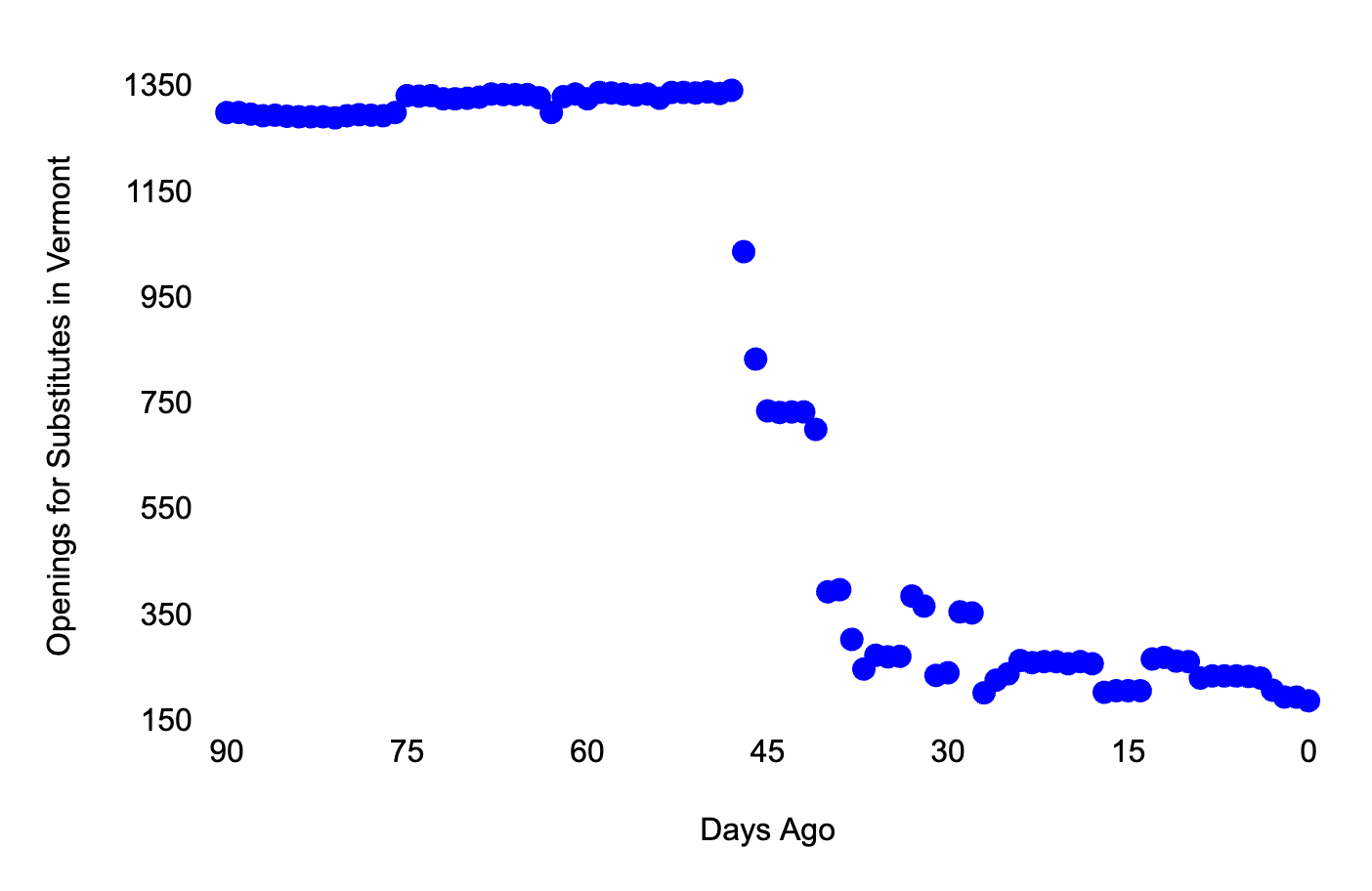
This issue of the 802 Ed covers many topics that are immediately useful like the latest legislative gridlock when it comes to education reform, supports for student mental health, and recent backlash against education technology. Be sure to check out the sudden drop in openings for substitutes in Vermont!
New to the lingo? At the suggestion of a reader we include a guide to common abbreviations, just scroll down past the news.
- Steven Berbeco, Editor

School Leadership
Be A Better Reference. Higher Ed Jobs gives advice on how to give the best possible support to someone who requests a letter of recommendation.
Voucher Money Shuffle. VT Digger explains how lawmakers are cautiously trying to redirect a new federal school choice tax credit program toward tutoring, summer learning, and other public-school supports for low-income students.
Making Matters Worse. The New York Times hands the pen to a college president who voices concerns about Yale University’s plan to restore public confidence in universities: “Shrink the mission, shrink the university.” Gift link
Benefits of Brain Breaks. The Hechinger Report focuses on teachers who design classrooms that respond to shrinking student attention spans by using hands-on activities, meditation, shorter lessons, and reduced screen exposure.
After The Freeze. The Waterbury Roundabout gives us the heads up that, after more than a year of delays and political wrangling, the U.S. Department of Education released $10+ million in overdue funding to Vermont’s schools and agencies.
Fewer Pixels in The Classroom. VT Digger examines the growing backlash against classroom technology, as lawmakers push bills to regulate educational software and give parents opt-out opportunities.
Supporting Students with Trauma. Edutopia offers practical advice on how to help keep students engaged when issues outside of school threaten to derail them.
Inbox Siege. Chalkbeat shines a light on education technology companies that exploit superintendents’ overloaded inboxes and limited decision-making time, raising concerns about how districts evaluate their products.
Bullhorn vs. Rulebook. Seven Days VT details how a Vermont college is threatening disciplinary measures against students who protested an adjunct professor’s online posts.
Students, Talk More in Class! Education Week shines a light on Kindergarten classrooms that limit children’s opportunities for sustained conversation, even though oral language development is a driver of later reading comprehension.
Field Trip to The Memory Factory. The New York Times describes how a student art contest tied to a planned National Garden of American Heroes has drawn criticism for turning civic education into a patriotic branding exercise. Gift link
$566,00 Settlement. Seven Days VT gets the scoop on the outcome of a lawsuit that alleged the VPA barred a school’s students from participating in sport competitions because of religious beliefs.
Possible Reduction in Force. Chester Telegraph breaks the story of a school board that is considering the “only option” after a failed budget vote. This was a popular item in last issue, so here it is again for readers who may have missed it.
Cookie House. The New York Times profiles a college where a tiny, always-open home stocked with baking supplies has become a sanctuary for community and late-night belonging for generations of students. Gift link
Heads Up, Vermont. States are taking innovative steps to support their students. Vermont school leaders and lawmakers should take note:
Colleges in Nevada replaced remedial math and English classes with “corequisite” classes, with great results.
A new law in Oklahoma doubles recess time in school across the state.
School Shootings in 2026. Education Week’s tracker has logged 11 school shootings in 2026. “On April 15, a 17-year-old was shot and injured in the Sepulveda Middle School parking lot in North Hills, Calif.” Total school shootings in 2025: 18. As a reminder, DPS and AOE operate an anonymous school safety tip line for students, school staff, and their community: calling 1-844-SAFE4VT; texting SAFE4VT to 274637; or online at safe4vt.org. For questions about school safety training in Vermont, contact Sunni Erikson.

Buzz On The Street
This sections highlights recent op-eds and letters to the editor about education.
Carl Henshaw wants us to know that preserving local schools is essential to the long-term viability of a town, warning that school consolidation would accelerate community decline: “An analysis of Act 46 found that merged and unmerged districts ultimately spent about the same - just in different ways.”
The Mountain Times editor argues that the House education reform bill may be imperfect, but the governor’s immediate rejection of it risks killing compromise needed to tackle the state’s spiraling finance problems.
Ann Manwaring makes the point that despite decades of school finance reforms, the state still lacks a meaningful accountability system connecting education spending to measurable results: “This is a systems failure, not a partisan dispute.”
The Saint Albans Messenger editor contends that the governor’s veto threats tied to education reform should be taken seriously, and suggests Democrats compromise as the governor appears willing to use his leverage in a prolonged policy standoff: “Legislators are reaching for the panic button.”
Sean-Marie Oller asserts that that Vermont is rushing toward sweeping education reform without first answering fundamental questions about costs, governance, and the real impact on students and communities: “Right now, we have more questions than answers.”
Reader Survey
In each issue we ask a survey question to get a sense of what is on our readers’ minds. Then, the following issue, we report back on what we learned.
Last issue we asked: Are you satisfied with the strategies that your school uses to prevent students from vaping? Responses were strongest for No, I feel that vaping is out of control. Few readers selected Yes, there is little or no vaping among students or I’m not sure whether students are vaping.
This issue’s survey question: Who should have primary responsibility for reducing youth vaping? Please indicate your response by clicking a check mark.
✅ State government, like AOE and VDH
✅ Supervisory unions, school districts, and schools
✅ I’m not sure
Thank you to the reader from Franklin County who suggested that survey question. What’s on your mind? Suggest a survey question to find out how your colleagues respond in an upcoming issue of the 802 Ed!

How Ya Doin’?
The start of the school year can be challenging for many reasons. It may be helpful to look for support around personal and professional issues. If you would like to schedule a time to talk with a rostered psychotherapist and VPA mentor, we can work on making small but significant steps that promote self-care, communication, and control. Sponsored by 802 Ed
Listen Up
Check out the 802 Ed’s conversation-style podcast! Generated by Notebook LM
Job Listings
Superintendent. Come lead the PK-12 Canaan school community and NEK Choice district, located in the state’s most beautiful region! Strong applicants will have a successful track record of visionary and systemic leadership, and extraordinary team building skills. The Board is willing to consider part-time employment or as an interim position. Sponsored by Essex North Supervisory Union
Supercharge The Applicant Pool. The market for school staff in Vermont is fierce and it’s important to stand out when attracting quality candidates. Why get wedged in among thousands of open positions on SchoolSpring? Your opportunity can stand out in an upcoming issue of the 802 Ed, dropping into the Inbox of thousands of readers. Sponsored by 802 Ed
School Leader Vacancies. Latest report from VPA counts 72 school leader positions, like principal and assistant principal, that are turning over for next school year.
The Big List. Josh Czupryk compiles and publishes a monthly spreadsheet with more than 700 job opportunities for remote work in K-12 education.
Looking for a Change? With so many open jobs in education, there are sometimes unusual opportunities in Vermont. For example, a college recently posted an opening for a Zero Proof Bartender who will curate drinks that are “appealing to college students using non-alcoholic ingredients.”

Thank The Team
You read it, you love it, and now is a good time to say thanks. Cover our coffee budget! Writing, editing, researching… all of that is caffeine driven. Choose this option and the extra energy will go to finding a few more updates to share.

Note From The Editor
In Vermont, we know what happens when the only bridge over a river closes in winter.
At first, there is confusion, then detours. Then panic. School buses creep down icy back roads never meant for heavy traffic. Communities discover that what looked like “just infrastructure” was actually the thing holding daily life together.
That is why educators across Vermont should pay close attention to the recently announced permanent closure of Jarrett House this June.
Run by Howard Center, Jarrett House is a six-bed crisis program that provides short-term stabilization for children who are experiencing acute mental health emergencies.
Six beds may not sound like much. But in a state as small as ours, six beds can function like a bridge across dangerous water.
Children who arrive at Jarrett House do not disappear when the program closes this summer. They will still be in crisis: dysregulated, traumatized, terrified, overwhelmed, or unable to function safely in traditional settings like, say, a classroom.
The difference is that, in the fall, schools will now inherit more of those crises without one of the state’s key stabilization options available. And surely our schools are already overloaded.
Educators have spent the last several years becoming accidental first responders in a youth mental health emergency. School leaders and staff balance compassion, classroom safety, legal obligations, and exhausted communities all at once.
Jarrett House helped relieve some of that pressure. Did it work? Heck, yes. Almost all the children admitted to Jarrett House were discharged to a lower level of care. This matters enormously for schools. Every stabilized child represents a classroom more likely to function and, frankly, a teacher more likely to remain in the profession.
Educators are often told to do more for mental health. And we have - heroically. But a public school, no matter how caring, cannot always safely absorb a child in acute psychiatric crisis without external support systems. Removing those supports does not eliminate the need. Instead, it simply reroutes it down icier roads.
Like closing the only bridge over a river, the consequences do not stay neatly at the closure site. In education, the consequences ripple out as more staff burnout, more interrupted learning, more emergency placements, more traumatized classrooms, and more families hanging on by their fingertips.
Vermont educators understand that when one piece fails, the burden migrates elsewhere. Jarrett House may have only six beds. But bridges are often narrower than the traffic they carry.
Eye on Data
The chart below tracks number of open positions for substitutes in Vermont in the past 90 days, presented as data points and no linear trend line this time. Data from SchoolSpring.
Pass It On
Like what you are reading? Hit the button below to send a copy to a colleague, friend, neighbor, your boss… whoever!

Grants & Opportunities
Student Rep for State Board. The State Board of Education has an opening for a two-year term as a student representative, for rising sophomores and juniors. Candidates submit a resume and letter of interest to EXE.Appointments@vermont.gov. Deadline is May 6.
De-Escalation Curriculum. Vermont’s Criminal Justice Council has posted an RFP for law enforcement, “grounded in adult learning principles with collaborative input from subject matter experts in behavioral health, instructional design, and law enforcement.” Deadline is May 8.
Consolidation of Funds. AOE is requesting public comment on a federal waiver that would permit consolidation of statewide professional learning, technical assistance, and program implementation funds. Deadline is May 11.
Intensive Needs. AOE has published an RFP for a contractor to train education teams on intensive special education services. Deadline in May 20.

802 Ed in The News
Last issue’s editorial on Pause Button Governance was also published in VT Digger, Times Argus, Rutland Herald, and Vermont Business Journal.
If You Missed It
Claude Comes to Vermont. The juggernaut of artificial intelligence has struck “full campus access agreements” with only three universities worldwide, including a college in the Green Mountain State.
Barnyard Book Club. A university program in Vermont pairs elementary students with horses to build reading confidence and emotional comfort. This was a popular item in last issue, so here it is again for readers who may have missed it.
How to Teach AI. Three university professors propose models of how schools can best integrate artificial intelligence into classroom teaching.
New Child Care Dashboards. DCF announced the launch of four new public data dashboards with information about child care and child development services in Vermont.
“Know Your Rights.” The ACLU has produced classroom videos for students on the topic of book censorship.

Since 2021 the biweekly 802 Ed has brought together the latest from Vermont’s associations for principals, superintendents, and school board members, as well as state and national education agencies and many other news sources. We hope that you’ll find something useful in each issue and welcome comments or suggestions for upcoming issues: editor@802ed.com.
Abbreviation list: AASA School Superintendents Association, AOE Agency of Education, CTE Career and Technical Education, DCF Department for Children and Families, DMH Department of Mental Health, DPS Department of Public Safety, FERPA Federal Educational Rights and Privacy Act, NAEP National Assessment of Education Progress, NEASC New England Association of Schools and Colleges, RFP Request for Proposals, SBE State Board of Education, SEL Social Emotional Learning, UVEI Upper Valley Educators Institute, VDH Vermont Department of Health, VEHI Vermont Education Health Initiative, VPA Vermont Principals Association, VPO Vermont Political Observer, VREC Vermont Rural Education Collaborative, VSA Vermont Superintendents Association, VSBA Vermont School Board Association, VSBIT Vermont School Boards Insurance Trust, VSBPE Vermont Standards Board for Professional Educators, VTCLA Vermont Curriculum Leaders Association, VTSU Vermont State University.
Special bonus for making it to the bottom: Only three people from “We Didn’t Start The Fire” are still alive.
How about an article on the Act 73 lawsuit by Liberty Justice Center to overturn that aspect of Act 73 that cuts off funding for many independent schools?