

The 802 Ed
What's going on in Vermont education policy and practice
Welcome back!
This issue of the 802 Ed covers many topics that are immediately useful like guidance on student free speech, truancy law changes, and a proposal for dyslexia reclassification. Be sure to check out the support for educator well-being!
New to the lingo? At the suggestion of a reader we include a guide to common abbreviations, just scroll down past the news.
- Steven Berbeco, Editor

School Leadership
Tee Shirt Tightrope. School Administrator hands the pen to an attorney who offers advice on how to balance students’ free speech rights with school disruptions.
Title IXed. Seven Days VT explains the recent federal investigation opened on a Vermont school district for permitting transgender students to compete on sports teams that align with their gender identity. This was a popular item in last issue, so here it is again for readers who may have missed it.
Speaking in Math. The Hechinger Report follows up on recent research that finds an association between teaching a richer set of math vocabulary and students’ academic achievement.
Escorted to School. The New York Times chronicles how immigration enforcement in the Twin Cities has turned schools into hyper-vigilant zones. Gift link
Cross-Border Learning. VT Digger reports on a bill that would allow school districts in a rural Vermont county along the Connecticut River to pay to send pre-K students to programs in New Hampshire.
Stress of Instant Grading. Education Week explores the downside of schools the use online portals where students and parents can get immediate updates on grades.
“Change Is Really Hard.” Vermont Public interviews the secretary of education, who reaffirms her support for school district consolidation.
Another Map. VT Digger picks up on the proposed redistricting map for Vermont’s schools from the chair of the House Committee on Education: “It’s not perfect, and it’s meant as a starting point, not an ending point.”
Supporting Across Classrooms. Education Week spotlights Vermont’s Teacher of the Year among educators across the country building networks to help each other cope with stress, isolation, and crises affecting students and schools.
Redefining Dyslexia. K-12 Dive explains the bills in Congress that would ensure dyslexia is in its own IDEA category.
Many Languages, One Message. Edutopia suggests systemic changes that can improve communication within a school community when English isn’t spoken at home.
Bueller? VT Digger reports on AOE’s proposed policy changes to overhaul truancy laws, and legislative testimony points out that one in four students in Vermont was chronically absent last year.
CTE Reset. Times Argus covers the secretary of education’s proposal to create a statewide Education Service Agency to standardize career and technical education programs.
Hallyu! The New York Times profiles the rapid growth of Korean in high schools and colleges, as even the reporter states that the article was written while listening to the “K-Pop Demon Hunters” soundtrack on repeat. Gift link
Heads Up, Vermont. States are taking innovative steps to support their students. Vermont school leaders and lawmakers should take note:
Alabama’s legislature is addressing the school bus driver shortage with a bill that would permit retirees to work full-time as drivers.
Nearly two dozen states have passed laws that regulate artificial intelligence in schools, despite federal push-back.
Alaska legislators are considering a bill to adopt a Bill of Rights guaranteeing local education for Deaf and hard of hearing children, joining twenty other states but ehem not Vermont.
School Shootings in 2026. Education Week’s tracker has logged zero school shootings in 2026. Let’s hope this number doesn’t change. Total school shootings in 2025: 18. As a reminder, DPS and AOE operate an anonymous school safety tip line for students, school staff, and their community: calling 1-844-SAFE4VT; texting SAFE4VT to 274637; or online at safe4vt.org. For questions about school safety training in Vermont, contact Sunni Erikson.

Buzz On The Street
This sections highlights recent op-eds and letters to the editor about education.
Leanne Harple argues that small, rural schools are strengths of their communities and shouldn’t be treated as problems that need to be fixed through consolidation or standardization: “A rural school isn’t a business mistake.”
Linda Smith puts forward the argument that Vermont must embrace difficult education reforms like consolidating districts and cutting administrative costs rather than clinging to nostalgia: “I love town schools. But I know that things have to change.” This was a popular item in last issue, so here it is again for readers who may have missed it.
Matt Wormser points out that Vermont’s education system needs substantive reform rather than more task forces: “Vermont’s legislative libraries are littered with reports that are read by few and never implemented.”
Mary Alice Bisbee argues that skyrocketing health insurance costs for education staff are squeezing school budgets and should be removed from education funding: “There is a simple solution.”
Katherine Quimby Johnson asserts that small elementary schools with low enrollments can limit students’ social development: “Tiny elementary schools can limit peer groups and undermine student growth.”
Jordan Hepburn contends that closing small rural schools chips away at the heart of community life and the ability to attract and retain families: “Keeping Calais Elementary School open will be one of the greatest assets to helping rebalance our community demographically.”
Jessica Grose argues that aggressive immigration enforcement has turned public schools into sites of fear and trauma for children and families, even as educators and parents respond with extraordinary collective care: “Welcome to the resistance, public school parents.” Gift link
Nancy Russell states that Vermont’s education reform debate will fail to control rising school costs unless it confronts the surging health care expenses baked into school budgets: “Health care costs are an education issue, a taxpayer issue, and an equity issue.”
Reader Survey
In each issue we ask a survey question to get a sense of what is on our readers’ minds. Then, the following issue, we report back on what we learned.
Last issue we asked: Do you support the Senate leader’s proposed spending cap for school budgets? Responses were strongest for No, there really isn’t anything more that can be cut, with few readers selecting Yes, school spending has gotten out of control and I’m not sure how I feel about it.
This issue’s survey question: What should Vermont’s education funding system emphasize? Please indicate your response by clicking a check mark.
✅ Cost containment and predictable taxes
✅ Equity of opportunity across schools
✅ Transparency and simplicity for voters
Thank you to the reader from Washington county who suggested that survey question. What’s on your mind? Suggest a survey question to find out how your colleagues respond in an upcoming issue of the 802 Ed!

How Ya Doin’?
The start of the school year can be challenging for many reasons. It may be helpful to look for support around personal and professional issues. If you would like to schedule a time to talk with a rostered psychotherapist and VPA mentor, we can work on making small but significant steps that promote self-care, communication, and control. Sponsored by 802 Ed
Listen Up
Check out the 802 Ed’s conversation-style podcast! Generated by Notebook LM
Job Listings
Principal. Come lead a dedicated and creative team of educators at U-32, a grades 7-12 high school serving about 650 students. Strong applicants will be innovative, collaborative, and equity-focused, with a successful track record of leading systemic change with a collaborative approach. Sponsored by Washington Central Unified Union School District
Principal. Lake Region Union High School is looking for a dynamic, student-centered, and visionary leader who is ready to accelerate the school’s academic excellence and community pride. Successful applicants will demonstrate facility with instructional leadership such as evidence-based practices and data-informed decision-making. Closing date for applications is February 27. Sponsored by NESDEC
Supercharge The Applicant Pool. The market for school staff in Vermont is fierce and it’s important to stand out when attracting quality candidates. Why get wedged in among thousands of open positions on SchoolSpring? Your opportunity can stand out in an upcoming issue of the 802 Ed, dropping into the Inbox of thousands of readers. Sponsored by 802 Ed
The Big List. Josh Czupryk compiles and publishes a monthly spreadsheet with more than 500 job opportunities for remote work in K-12 education.
Looking for a Change? With so many open jobs in education, there are sometimes unusual opportunities. For example, a college in Vermont is recruiting for an Abenaki language instructor. Chowi, n’gwaskwaji. Pebonwiwi. (Sure, I’m cold. It’s winter.)

Thank The Team
You read it, you love it, and now is a good time to say thanks. Cover our coffee budget! Writing, editing, researching… all of that is caffeine driven. Choose this option and the extra energy will go to finding a few more updates to share.

Note From The Editor
Spoiler alert: I’m going full policy nerd with this one.
Did you catch the governor’s budget address? It served up a familiar menu of state revenues that support Vermont’s schools: sales tax, lottery dollars, rooms and meals, and the vehicle purchase and use tax. Then came the twist: signaling a move to pull back from those sources, shrinking the state’s role in funding public education.
This is not a plan to control costs. It is a plan to cut the system.
Vermont has never funded its schools with property taxes alone. State revenues exist to spread the responsibility and protect homeowners and renters from great swings. Narrowing that revenue base does not make education cheaper. It makes it shakier.
Instead of tackling real cost drivers like rising health care expenses, the budget shifts money around. Roughly $10 million would be redirected from the Education Fund to the Transportation Fund. Those dollars don’t vanish. They move from classrooms to highways, from students to asphalt.
For sure, no one is on Team Pot Holes and the transportation department needs funding to do its work. But there are better ways to raise the dollars, like through taxing electric vehicles that aren’t contributing to road repair through the gas tax.
We are told property taxes are the problem. Yet even when more state revenue has flowed into schools, property taxes have increased because education costs keep rising. Pulling out statewide revenue while ignoring those cost drivers guarantees instability, especially for small and rural districts.
Everyone can get behind lower property taxes, but weakening the Education Fund is not the way to get there. From Alburgh to Windham, it shifts risk onto communities least able to absorb it.
Vermont’s students are not a budget line to squeeze until something breaks. We should choose kids over asphalt.

Eye on Data
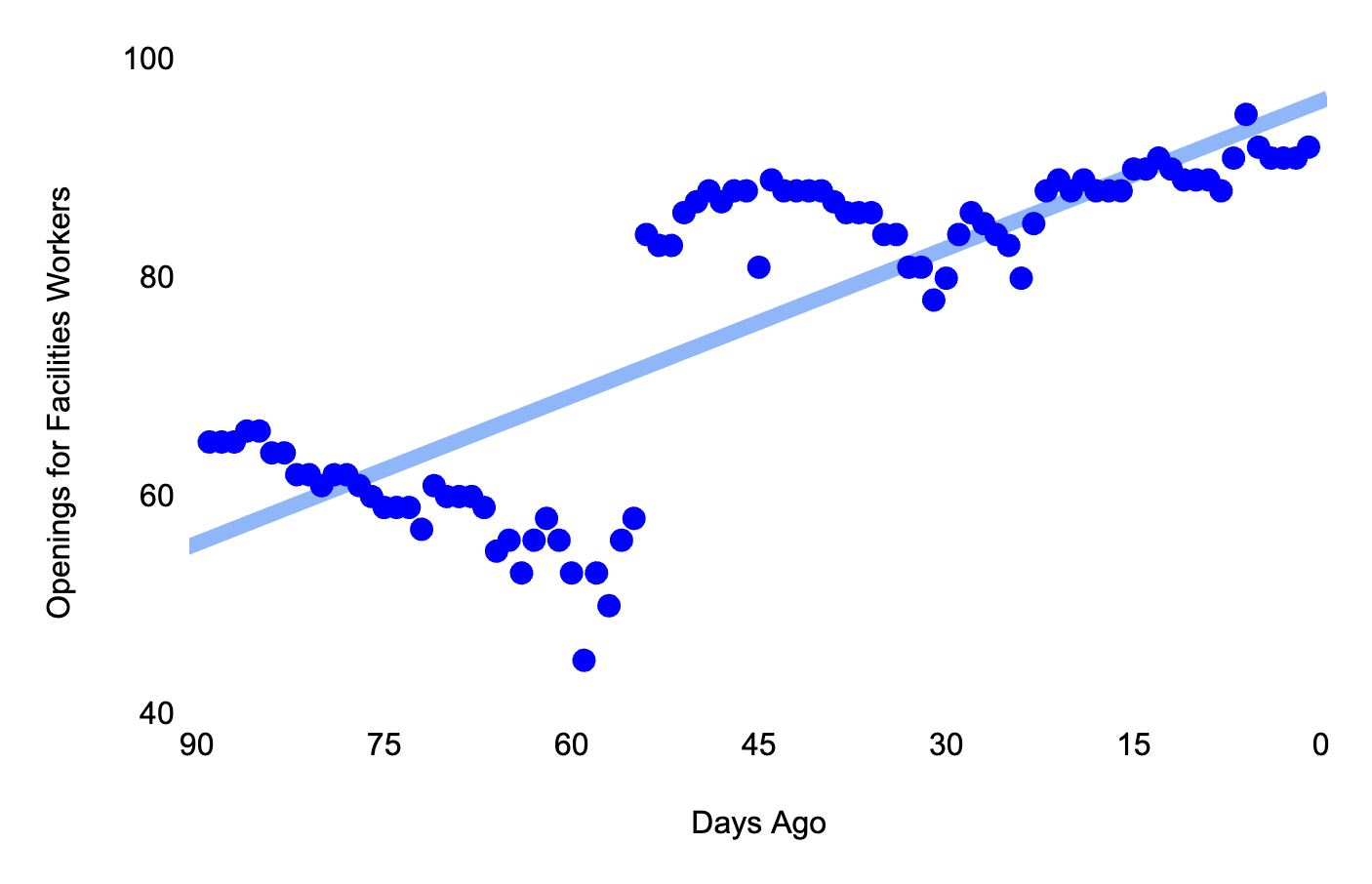
The chart below tracks number of open positions for facilities workers in the past 90 days, presented as data points and a linear trend line. Data from SchoolSpring.
Pass It On
Like what you are reading? Hit the button below to send a copy to a colleague, friend, neighbor, your boss… whoever!

Grants & Opportunities
“For the Love of the Land.” Clemmons Family Farm is offering no-cost lesson plans for grades K-8 about the Clemmons Farm, a national historic landmark in Vermont, through storytelling, mindfulness activities, music, poetry, and gardening projects. Access available January 26 to March 31.
Preamble Poster. The Smithsonian offers a free teaching poster of the first lines of the Constitution, spelled out in license plates.
Vermont FEED. Shelburne Farms is hosting the Northeast Farm to School Institute, a year-long professional learning opportunity that starts in the summer and helps teams build robust farm to school programs. Deadline is February 9.
Student Town Hall. Senator Sanders is hosting a virtual town hall for high school students to discuss issues facing young Vermonters, and requests recommendations for active student participation. 7 pm, February 10.
Summer Camp. AHS has posted an RFP to host a summer camp for students with disabilities, with a maximum award of $250,000 per year. Deadline is February 13.
Teaching Financial Literacy. Champlain College is offering a no-cost three credit graduate-level course in March and April for middle and high school educators. Deadline is February 19.
Presidential 1776 Award. The U.S. Department of Education announced a national competition for high school students testing knowledge of the country’s founders, its Constitution, and the Revolutionary War. Online test available February 22 to 28.
Aligning Pre-K. DCF has posted an RFP for a contractor to develop an integrated statewide framework for Universal Pre-K. Deadline is February 25.
Make A Pitch. The Mott Million Dollar Challenge invites K-12 students to submit a world-changing idea with a short video. Deadline is February 27.
Superintendent of the Year. The VSA has opened its award nomination process, noting that nominations can come from any person in the Vermont education community such as superintendents, principals, central office staff, teachers, school board members, and community members. Deadline is March 13.

If You Missed It
Black History Month Resources. The Smithsonian’s National Museum of African American History and Culture offers access hundreds of free preK–12 classroom and at-home resources.
Four Day Gamble. A recent research paper explores the four-day school week, its negligible effect on teacher turnover, and small savings on services and salaries.
Early Education Workforce. DCF’s Child Development Division recently published a report indicating a marked increase in the regulated early childhood and afterschool workforce with rising educational attainment.
Talking Fearlessly about Fear. Facing History and Ourselves offers a four-page guide to teaching about current events.
Mental Health in Schools. Vermont’s representative joined others in Congress to introduce the Mental Health Career Promotion Act, which would provide funding to schools to establish mental health career promotion programs for students.
Vermont Gets A ‘B.’ A national coalition published grades for how states have implemented cell phone restrictions in schools, or not at all in many cases.
Year of The Horse. The Smithsonian offers teaching resources about food, music, and many other topics about Lunar New Year, which falls on February 17 this year.
“Academic Harm.” A position paper from the National Council of Supervisors of Mathematics warns of the hazards of not basing instructional and policy decisions on a broad, critically evaluated body of empirical research.

Since 2021 the biweekly 802 Ed has brought together the latest from Vermont’s associations for principals, superintendents, and school board members, as well as state and national education agencies and many other news sources. We hope that you’ll find something useful in each issue and welcome comments or suggestions for upcoming issues: editor@802ed.com.
Abbreviation list: AASA School Superintendents Association, AOE Agency of Education, CTE Career and Technical Education, DCF Department for Children and Families, DMH Department of Mental Health, DPS Department of Public Safety, FERPA Federal Educational Rights and Privacy Act, NAEP National Assessment of Education Progress, NEASC New England Association of Schools and Colleges, RFP Request for Proposals, SBE State Board of Education, SEL Social Emotional Learning, UVEI Upper Valley Educators Institute, VEHI Vermont Education Health Initiative, VPA Vermont Principals Association, VPO Vermont Political Observer, VREC Vermont Rural Education Collaborative, VSA Vermont Superintendents Association, VSBA Vermont School Board Association, VSBIT Vermont School Boards Insurance Trust, VSBPE Vermont Standards Board for Professional Educators, VTCLA Vermont Curriculum Leaders Association, VTSU Vermont State University.
Special bonus for making it to the bottom: You know those small bags of silica gel, a desiccant tucked into sneakers, seaweed snacks, and everything else? A gram of it has nearly the same surface area as two basketball courts.